

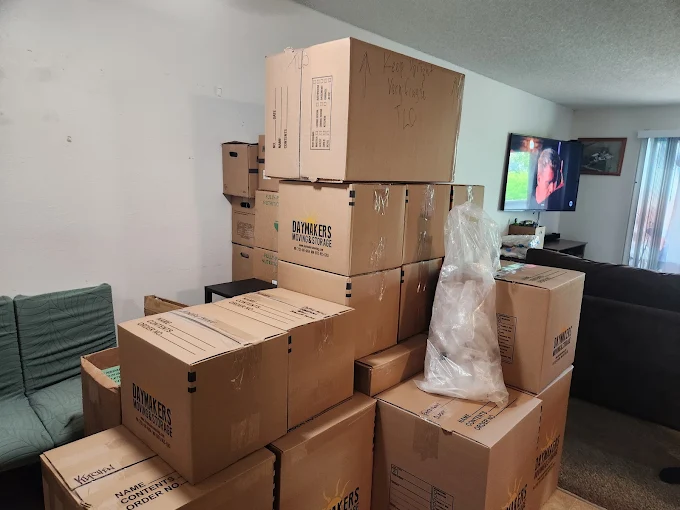
Start packing six weeks before moving day for a full house, three weeks for a townhome or condo, and two weeks for an apartment. Those numbers assume a few hours on weeknights and a longer session each weekend, which is how most households actually pack, not how packing gets imagined.
Our crews at Daymakers Moving & Storage load homes across Lake Elmo and Washington County year-round, and the pattern is pretty consistent: people underestimate the kitchen, the garage, and the basement by roughly half.
Booking expert movers in Lake Elmo, MN, early gives you an estimator who can tell you how much you’re actually packing, since volume is kind of the thing nobody judges well from memory. So count boxes, not days. And start with the room you use least.
How Long Packing a Whole House Actually Takes
A three-bedroom house holds more than it looks like it holds, and packing it properly runs somewhere between twenty and forty hours of real work for most households. Spread across six weeks, that’s manageable.
Squeeze it into the final weekend, though, and it becomes the reason boxes arrive unlabeled, fragile items travel loose, and the crew ends up waiting around for the better part of an hour.
Household composition changes the math more than square footage does, which surprises a lot of people. A family with young children packs in shorter bursts and loses ground to daily life, and moving with kids just has a rhythm of its own, so plan around it rather than fighting it.
A couple moving out of a condo can clear it in a handful of focused evenings. Long-tenure households, you know, the ones who’ve been in the same Lake Elmo house for fifteen years, need the full six weeks and often more, which local movers see all the time.
What to Pack Six Weeks Out
Begin with anything you won’t miss, because early packing shouldn’t disrupt daily life. Out-of-season clothing, holiday decorations, books, spare bedding, framed art, guest room contents, and closets you open maybe twice a year all qualify. These items pack quickly too, which builds a bit of momentum while the work is still easy.
Storage spaces come next, and honestly, they’re the ones people put off. Basements, garages, and outbuildings hold years of accumulation, and they need sorting decisions, not just boxes.
Most packing and storage tips boil down to three outcomes here, keep, donate, and discard, because packing something you plan to get rid of means paying to move it twice. Lake Elmo properties with detached garages or sheds should add a weekend for that space alone.
Which Rooms Take the Longest
The kitchen is the slowest room in any house, and it routinely takes two to three times what people allow for it. Every item is a different shape, most of it is fragile, and each piece needs individual wrapping rather than being stacked. Plan two full sessions for a family kitchen, and use proper dish cartons, not the boxes the grocery store gave you.
Garages and basements aren’t far behind, though for a different reason. Tools, sporting equipment, paint, lawn chemicals, and half-finished projects all need sorting before packing, and some of it can’t travel at all.

Fuel, propane, solvents, and most flammables stay behind, so budget a trip to a disposal site rather than finding out on the moving morning. Bedrooms and living rooms are fast by comparison, so they belong in the final week, when organizing boxes by room keeps things from getting chaotic.
What Belongs in the Last Week
The final week is for the things you use, packed in the order you stop needing them. That means kitchen items beyond a few plates, the rest of the clothes, bathroom supplies past the basics, and anything that’s been holding the house together while you packed everything else.
Keep one box per person of daily stuff and label it clearly so it travels last and gets opened right away.
Set aside a separate group that doesn’t go on the truck at all. Medications, documents, valuables, chargers, keys, and a change of clothes travel in your own vehicle, and marking a do-not-move zone keeps a well-meaning crew from loading them. Just tell us where that zone is when we arrive, and we’ll work around it.
Four weeks out and the boxes just aren’t filling up? Give us a call at (651) 317-8713, and we’ll do a quick walkthrough of your Lake Elmo home and take the packing off your plate. No pressure, just a look at what it would involve.
What to Have Ready If Our Crew Is Packing for You
Full packing service changes the timeline entirely, since the work happens in a day or two instead of six weeks. Still, a little prep on your end goes a long way. Before the crew arrives:
- Separate what is not being packed, including the do-not-move items and anything being discarded
- Clear counters and floors so the crew has working surfaces
- Point out fragile and high-value pieces individually rather than assuming they will be spotted
- Empty and defrost appliances, and dry them thoroughly
- Plan for pets, since doors stay open for hours
Our packing services cover the whole house or just the rooms you’d rather not handle, and the kitchen is the most common room people hand over. Fragile items get wrapped and boxed by people who do it daily. That’s a very different outcome than a rushed Saturday.
What Happens If You Run Out of Time
Falling behind is common, and it’s fixable. Partial packing service exists for exactly this, where the crew handles the kitchen and the fragile items while you finish the rest, and it can often be arranged on short notice when schedules allow. Call as soon as you know, not the night before, because crew availability is the limiting factor.
The alternative most people reach for is throwing everything into unlabeled boxes on the last night, and it costs more than it saves. Unlabeled cartons get placed wrong, which means you move them again yourself, and loosely packed fragile items are the ones that arrive broken. Ten minutes of labeling saves an hour of unpacking. Every time.
Frequently Asked Questions
Two weeks is usually enough for a one- or two-bedroom apartment, working a few hours at a time. Start with closets and storage, leave the kitchen for the final days, and keep one box per person of daily items to load last. It’s a smaller job, sure, but it still sneaks up on people.
Packing yourself costs time rather than money, and it works when you have six weeks and a house of moderate volume. Hiring packers makes sense when the timeline is short, the kitchen is large, or the household includes fragile and high-value items that need proper materials. Some people split it, maybe handing over just the kitchen, and that’s a perfectly good middle ground.
Flammables, fuel, propane, solvents, most aerosols, and perishable food stay behind. Medications, documents, jewelry, electronics you need right away, and anything irreplaceable travel in your own vehicle, not in the load. If you’re unsure about something, just ask before moving day.
Dish cartons are thicker-walled and built for the weight, and they matter more than any wrapping technique. Plates travel on edge rather than stacked flat, with padding between each one, and the box gets filled so nothing shifts. It sounds a bit fussy, but it’s kind of the whole difference between plates that arrive fine and plates that don’t.
Get Help With a Lake Elmo Move
Our Lake Elmo team quotes packing and moving together after seeing the home. Call (651) 317-8713, email daymakersmoving@gmail.com, or visit us at 8530 Eagle Point Blvd Suite 100 #132, Lake Elmo, MN 55042. Contact us to request a free quote. We’re open Monday through Friday, 8 am to 5 pm, Saturday 8 am to noon, and Sunday by appointment.
