

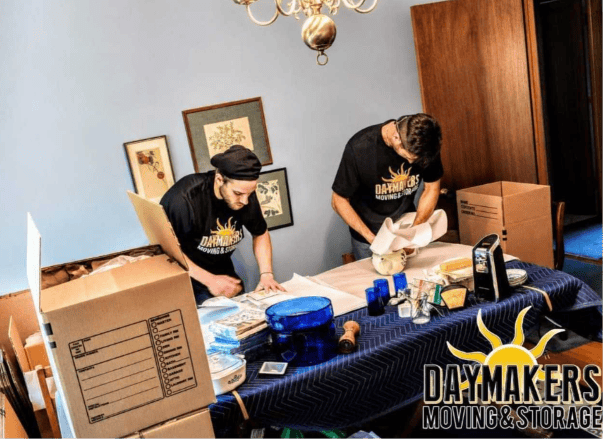
Most people buy too many large boxes and not enough small ones, then run out of tape on the last night. That single pattern causes more moving-day trouble in Eau Claire than any other packing mistake. An overloaded large box either fails on the stairs or cannot be safely carried at all. We are Daymakers Moving & Storage. Professional movers at Daymakers Moving & Storage have loaded enough households out of this city to know a well-supplied packing job on sight. The supply list below is built around how boxes behave under load, not around what a hardware store sells in a bundle.
The Boxes You Need, and in What Proportion
Small boxes carry the heavy things. Books, tools, canned goods, dishes, anything dense. They look absurd when you are filling one with hardcovers, and they are the reason your books arrive in one piece. Buy more of these than feels reasonable. Roughly half your total box count should be small once the kitchen and the shelves are done.
Medium boxes take the bulk of a household: small appliances, pantry goods, toys, electronics, files, most of what lives in a cupboard. Large boxes are for volume without weight, meaning bedding, pillows, lampshades, winter coats and comforters. The rule that prevents most damage is simple. If you cannot comfortably lift a box yourself, it is too heavy. A mover carrying it down a narrow older staircase off Water Street has a harder job than you did in a flat kitchen. For anyone weighing whether to buy all of this and do the work themselves, 10 reasons to use a packing and unpacking service lay out the case for handing at least part of it over.
Specialty Boxes Worth the Money
A handful of purpose-built containers earn their cost, and the rest usually do not:
- Dish packs and cell dividers. Double-walled, with inserts that keep glassware from meeting. The single best value in packing materials.
- Wardrobe boxes. A hanging rail inside, so clothes move straight from closet to box to closet. They save hours and eliminate ironing.
- Mirror and picture cartons. Adjustable flat boxes for framed art, mirrors, and televisions. Flat items packed in ordinary boxes rarely survive.
- Mattress bags. Non-negotiable for anything going into storage, and worth it on any move where the truck sees rain or dust.
Skip the rest unless you have a reason. Specialty file boxes, lamp boxes, and similar products solve problems that a properly packed medium box and enough paper already solve. If you would rather hand the decision over, moving and packing guide sets out what full-service and partial packing each covers. Compare that cost against your own weekend.
Cushioning: Paper, Bubble and What Goes Where
Packing paper does most of the work. Unprinted newsprint, bought by the bundle, used generously. It wraps individual items, fills the gaps between them, and lines the top and bottom of every box. Newspaper is the tempting substitute, and it transfers ink onto dishes, glass, and anything porous. A free material turns into an afternoon of washing.
Bubble wrap is for fragile, specific items: electronics, ceramics, glass, or anything with a protruding piece that could snap. Small-cell bubble suits flat surfaces, while large-cell bubble cushions weight. Furniture pads wrap around wood and upholstery, and stretch wrap holds those pads in place while keeping drawers and doors shut in transit. Stretch wrap should never sit against a finished wood surface for long stretches in summer heat, since trapped moisture and finish don’t mix. This same standard of care carries into every packing service handled, whether it’s a full household or a single specialty item, like a piano or antique cabinet.
Tape, Markers and the Small Things That Stall a Move
Buy more tape than you estimate, then buy one more roll. Packing tape at two inches wide, with a dispenser gun rather than the hand-tear rolls that jam. Three strips across the bottom seam of every box, one down the middle and one on each side. Boxes fail from the bottom, and they fail while being carried.
Permanent markers in a color that reads on brown cardboard, and more of them than you think. They vanish during a move at a rate that defies explanation. Add furniture sliders for hard floors and a basic tool kit for disassembly. Resealable bags hold the hardware from every piece you take apart, and a roll of stretch film tames the cords. Tape each hardware bag directly to the piece it came from. The alternative is a bowl of anonymous screws and an evening spent guessing.
How Much of Everything Should You Buy?
Box counts scale with how long you have lived somewhere more than with square footage. A one-bedroom apartment usually lands between fifteen and thirty boxes. A two- or three-bedroom home commonly runs forty to seventy. A larger family home with a full basement and a garage can pass a hundred without anyone being a hoarder about it.
Buy in stages rather than all at once, one of the more useful packing and moving hacks we give customers. Start with half your estimate, pack the easy categories, then reassess once you can see how the count is trending. Most stores in the area take back unused, unflattened boxes with a receipt. A walkthrough with us beats any online calculator, because we are looking at your actual shelves rather than a floor plan.
Not sure whether to trust an online box calculator over your actual shelves? Give us a call at (715) 500-6172, and we’ll walk it with you and tell you plainly what you need.
Where to Find Supplies Around Eau Claire
New boxes come from home improvement stores, office supply shops, truck rental counters, and moving companies, including ours. Buying new matters more than people assume. A box that has been compressed once has lost structural strength, and a stacked truckload is the wrong place to find that out.
Free boxes have their place for the lightweight and the non-fragile. Liquor stores carry small, sturdy dividers. Bookstores and offices generate a steady supply. What to avoid entirely is grocery produce boxes. They are often damp, frequently open-topped, and occasionally carrying pests you do not want in a new house. Anything free should be dry, clean, unbroken at the corners, and still square.
What Changes If You Are Storing Instead of Moving Straight In
Storage rewards better materials. Uniform box sizes stack more stably and survive months of load better than a mixed pile. Mattress bags become mandatory rather than optional. Plastic bins beat cardboard for anything sitting long-term, and the inventory list you write becomes genuinely useful rather than a nice idea.
Climate-controlled storage holds a unit at a stable temperature and humidity. That protects wood furniture, electronics, artwork, and instruments across a Wisconsin year. Even so, pack as though conditions will vary. Nothing damp goes in, nothing perishable goes in, and anything with a finish gets padded rather than shrink-wrapped. Label every box on two sides so you can read the stack without dismantling it.
Not sure how much of any of this your household needs? Call (715) 500-6172 and our Eau Claire team can walk through it with you and tell you plainly, including which parts are worth handing over and which you’re better off doing yourself.
Related Topics:
