

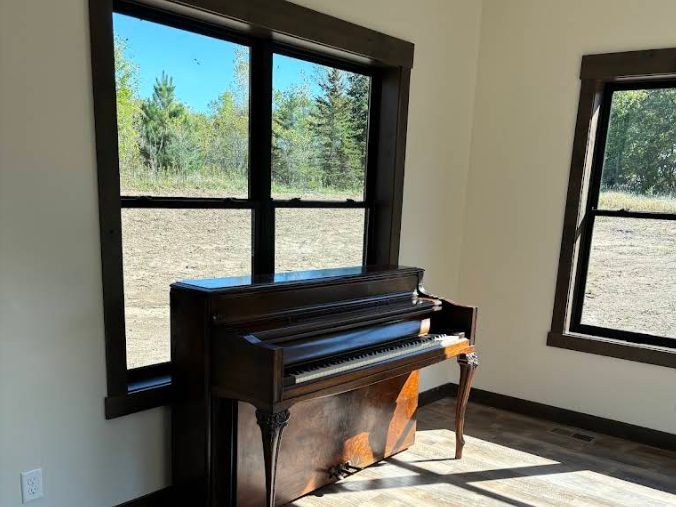
Heavy items move on equipment, not on extra people. A piano or a gun safe goes on a skid board or a stair-climbing dolly, with straps rated for the load. The crew agrees the route out loud before anything is lifted.
We are Daymakers Moving & Storage, a moving company working out of Bloomington, MN, since 2015, and we price this work from a walkthrough. Weight is only part of what makes it hard. Tell any mover about the stairs and the turns before you ask for a number.
Why Weight Is the Smaller Problem
An upright piano and a mid-size gun safe sit in roughly the same weight class. Both are well within what a trained crew handles on a normal day. What separates them from a loaded dresser is how the weight is arranged. A piano carries most of its mass high and toward the back, so it wants to tip the moment it leaves level ground. A safe carries its mass low but concentrated, which makes it unforgiving on anything not rated to hold it.
That shape problem is why volunteers get hurt. Six people can lift an upright. They cannot control it on a landing once the leading edge starts to go. There is nowhere to stand and nothing to brace against. Equipment replaces that scramble with something predictable, and a strapped load on a skid board behaves the same way on every step. The same logic governs weight distribution in a loaded truck, where how the mass sits matters more than how much there is.
What a Crew Checks Before Anything Moves
The walkthrough is where this job is won or lost. We measure the narrowest point of the route rather than the widest, since the narrowest decides whether the piece goes at all. Door frames get measured with the slab on and with it off. Removing a door and its hinges buys a couple of useful inches. Turns at the bottom of a staircase get more attention than the staircase itself. That is where a long item runs out of room.
Then the structure gets a look. A floating floor, a deck, an exterior landing or a basement stair with open risers each carry their own limits. A safe that is fine on a slab is not automatically fine on a wooden landing. We ask where the piece will sit permanently, and whether that spot can hold it long term. A customer who learns that on delivery day has already lost the chance to choose somewhere else.
How a Piano Is Moved, Step by Step
The sequence rarely changes from job to job, and knowing it tells you whether the crew in front of you has done this before. Watch how much happens before anyone touches the instrument. Most of the work is preparation, and the actual lift is the shortest part of the morning. A crew that starts by wrapping rather than by talking through the route is a crew to question.
- The route is agreed out loud, including who calls the stops and which way the piece turns at each corner
- The lid is closed and locked, the keyboard cover is secured, and casters are checked rather than trusted
- Moving blankets go on in layers, held with straps rather than tape, so nothing touches the finish directly
- An upright goes onto a four-wheel piano dolly, while a grand has its legs and pedal lyre removed before the body is lowered onto a padded skid board
- Floors and door frames get protected along the whole route, rather than just at each end
- The piece is strapped to the truck wall with an E-track system, upright and secured, never lying flat against other freight
Tuning is the part people forget. Any piano that has been moved needs tuning once it has settled into the new room, and settling takes weeks rather than days. Book the tuner for a month out instead of the week of the move. A piano tuned before it has acclimated will simply drift again.
Gun Safes and Heavy Safes Are a Different Job
A safe is denser and far less forgiving than a piano, and the main risk is to the building rather than to the safe. Stair-climbing equipment carries the load one step at a time under control. That is the only sensible way down a flight with that much concentrated weight. Doors come off the safe where the model allows it. Removing the door takes a real share of the weight out of the equation.
Placement at the destination deserves a conversation before the truck arrives. An upstairs room, a floating floor or an older house with a long joist span may be the wrong home for a heavy safe. We would rather raise that at the walkthrough than on the landing. Gun safes and heavy safes get the same equipment and planning as piano moving, and on both, the assessment matters more than the lift.
What It Costs and What Changes the Number
A specialty item is priced on access and risk, not on weight alone. The same upright can be a straightforward job from a ground-floor room with a wide door. It becomes a long one from a split-level with a tight turn at the base of the stairs. Flights of stairs, the narrowest doorway, an exterior landing and the distance to the truck all move the number more than the item does.
The honest way to find out is a walkthrough, in person or by live video. Someone sees the route instead of hearing it described. Phone estimates on specialty items are guesses, and the correction lands on your driveway. Ask for the item to appear as its own line on the written estimate. That shows what the specialty handling costs separately from the rest.
When a Piano or Safe Should Not Be Moved Today
Some days the answer is to stop. Ice on an exterior route changes the risk on a heavy piece more than anything else does. A slip with a strapped load has nowhere good to go. A route measured in summer and now banked with snow is a different route. We would rather reschedule than force a piece through a doorway it does not clear.
Some pieces need a specialist first. A grand going into long-term storage should go into climate control. A very old or structurally fragile instrument sometimes needs a piano technician to look at it before a mover touches it. If something does go wrong, the paperwork matters. Understanding how damage claims get handled is easier before the item is loaded than after.
Frequently Asked Questions
Can regular movers move a piano, or do I need a piano specialist?
How many people does it take to move a gun safe?
Will my piano need tuning after the move?
Can a piano go into storage over a Minnesota winter?
Contact Us About a Piano or Safe Move
Specialty items are easier to price and safer to move when we see the route first. Call our Bloomington office at (651) 461-1951 to arrange an in-person or live video walkthrough. You can also come by 8400 Normandale Lake Blvd #920, Bloomington, MN 55437. We are open Monday through Friday from 8 am to 5 pm, Saturday from 8 am to noon, and Sunday by appointment.
Related Topics:
