

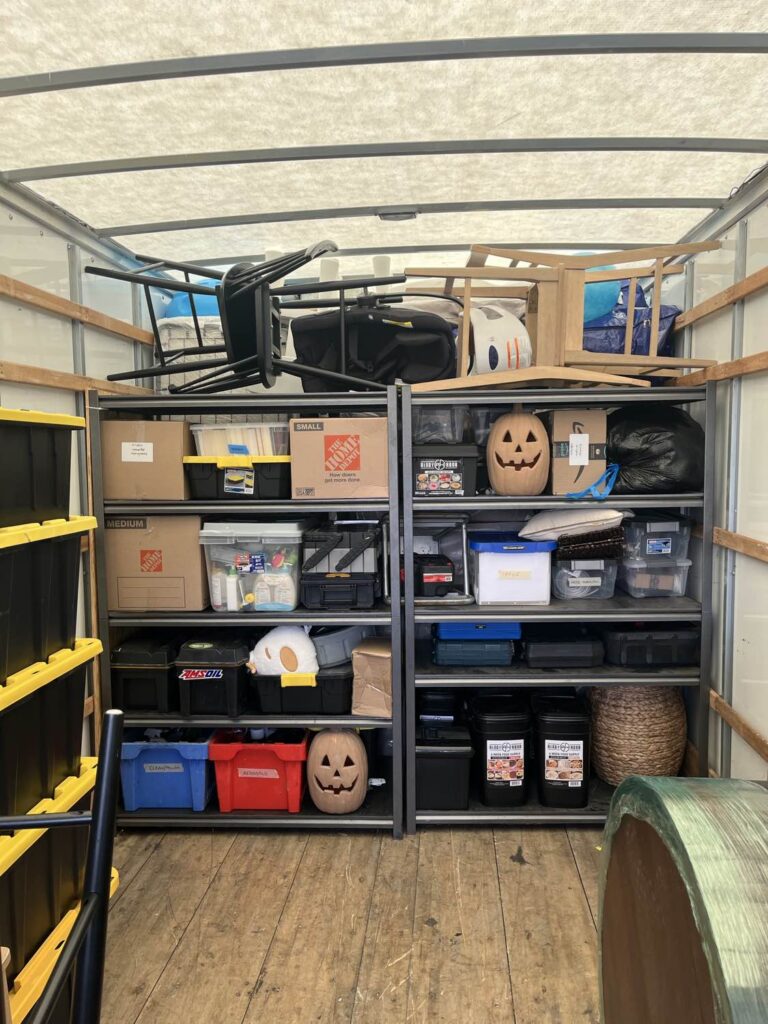
Weight in a moving truck belongs low, forward, and tight against the walls, because a load that shifts in transit is what breaks furniture and makes a truck handle badly. Most damage people blame on rough handling actually happens while the truck is moving, when a poorly packed wall of boxes leans into a dresser for twenty minutes on the freeway.
Every truck gets loaded in tiers for that reason by professional movers, heaviest items against the front wall and nothing left free to travel. The way a truck is packed in the first ninety minutes decides what comes off it at the other end
What actually happens to a load in transit
A truck body is not a sealed box. It flexes, it bounces over expansion joints, and it leans through every ramp and roundabout between your old address and the new one. Anything with room to move will move, and it will keep moving for the entire drive. A box that slides four inches each time the truck brakes has slid a few hundred times by the time you arrive.
The damage that results rarely looks dramatic. It shows up as a scuffed table leg, a cracked picture frame, a dresser with its veneer rubbed through where a plastic bin sat against it. None of it happens in one violent moment, which is why people struggle to work out when it occurred. It happened gradually, over fifty miles, because nothing was holding it still.
Heavy items go low and forward
The front wall of the trailer, the one nearest the cab, is where the heaviest things belong. Appliances, safes, filing cabinets, and the largest case goods go there first, stacked against the wall and strapped off before anything else is loaded. That puts the mass over or ahead of the axle rather than hanging off the back, which is what keeps the truck stable when it corners and stops.
Height matters as much as position. Weight stacked high raises the center of gravity and makes the whole vehicle lean harder into turns, so dense items stay near the floor and light, bulky things go up top. A wardrobe box full of coats can sit above a dresser without issue. A box of books cannot. When people load their own rentals, this is the rule they break first, usually because the heavy boxes came out of the house last.
Gaps are the problem, not the weight
A full truck packed tightly rides better than a half-empty one carrying the same furniture, which surprises people. Empty space lets items build momentum before they hit something, and a box that travels eight inches before making contact does far more damage than one that never moves at all. Professional loads are built to eliminate voids, not just to fit everything in.
That is what all the padding is doing. Moving blankets, mattress cartons, and loose soft goods get worked into the spaces between hard items so the load becomes one mass rather than a collection of separate objects. Straps go across each tier as it is completed, so that if anything does settle, it settles a fraction of an inch. The same thinking applies to specialty pieces, which we cover in more detail in our guide to moving large furniture and specialty items.
Not looking forward to spending a Saturday figuring out where the piano goes in a rental truck? Give us a call at (651) 461-1951, and we’ll build the load for you instead.
Why the drive itself changes the equation
A move across Bloomington, MN, and a move to another state are different loading problems even with identical contents. A short local run rarely exceeds forty-five minutes of driving, and the load only has to survive a handful of stops and turns. A truck heading to Denver spends two days flexing over interstate joints, climbing grades and braking on long descents, and everything inside it gets worked on the whole time.
Long-distance movers build those loads differently as a result, with more tiers, more strapping, and more attention to what sits against what. Your belongings travel on our own truck rather than being consolidated with other households, which means the load is built once for your shipment and is not broken down and restacked at a terminal along the way. Every time a load is rebuilt, it gets another chance to be built wrong.
Where self-loaded trucks usually go wrong
Three mistakes account for most of it. People load in the order things come out of the house rather than by weight; they leave a large gap at the back because the truck was bigger than they needed, and they skip strapping entirely because the tiers looked stable while parked. All three feel fine in the driveway and reveal themselves somewhere around the first hard stop.
The fourth is less obvious. Weight concentrated over the rear axle makes the steering feel light, and on a truck most people have never driven before, that is a genuine safety issue rather than a furniture problem. If the back end feels floaty or the front end feels vague, the load is wrong, and it needs to come off and go back on. Almost nobody does this, which is why rental trucks arrive with rubbed furniture so often.
How a trained crew builds a load
A crew that works together has a system, and the system is why loading looks so much faster when professionals do it. Someone stages items near the truck in the order they will be needed, someone builds the tiers, and the load goes up in a planned sequence rather than whatever arrives at the ramp next. Getting there takes practice, which is part of why our crews are our own trained movers instead of temporary labor hired on the morning.
The walkthrough before the truck arrives feeds directly into this. Knowing in advance that there is a marble tabletop, a chest freezer, and a wall of book boxes lets us plan where each goes before anyone lifts anything. Customers notice this part on the day itself, and it is one of the things that comes up repeatedly in our reviews: that the loading looked organized rather than improvised. Our walkthrough of what happens on moving day covers how the sequence runs from arrival to final inspection.
Planning a move in Bloomington, MN and want the truck loaded by people who do it every day? Call (651) 461-1951 to book a walkthrough with our Bloomington crew, and we’ll price the job based on what is actually in the house.
Related Topics:
