

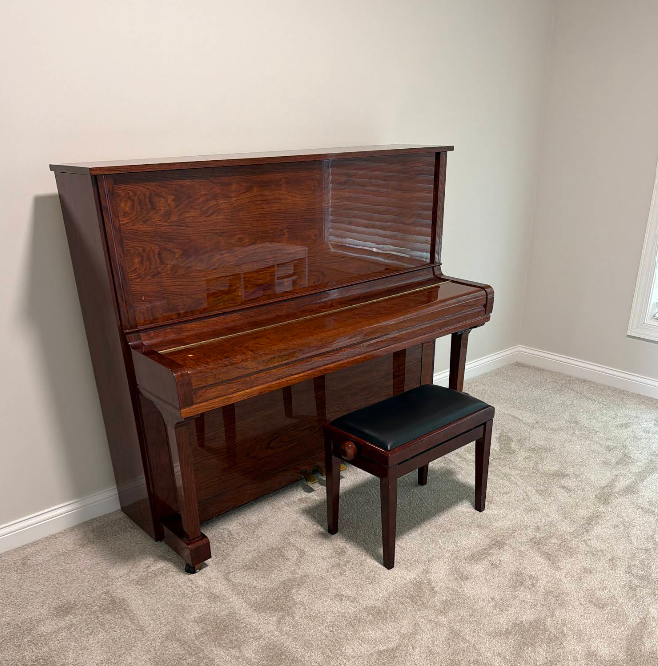
An upright piano weighs more than most sofas, and all of that weight rides on four small casters never meant to cross a doorway. Moving one is a planning problem before it is a lifting problem. Crews train for each item’s weight and balance, and skilled professional movers flag every piece at the walkthrough, whether it’s a piano, a gun safe, or a riding mower.
What Makes an Item a Specialty Move
Weight alone does not define a specialty item. Distribution does. A gun safe concentrates several hundred pounds into a small footprint, which is what tears flooring and cracks thresholds when it gets tipped wrong. A pool table is heavy in a different way, with a slate bed that comes apart in sections.
Pianos sit in their own category because the weight shifts as the instrument tilts. The frame holds tension across the strings, and the shape puts most of the mass toward the back. A crew that has moved sofas all week will not read that correctly on instinct. Our teams train on these items specifically, including which ones get disassembled and which travel whole.
How We Plan a Specialty Item Move
- Pianos: piano boards, padding, straps, and a crew sized to the instrument type
- Gun safes and heavy safes: weight-rated equipment and floor protection along the whole path
- Pool tables: slate disassembly, separate crating, and reassembly at the new address
- Riding mowers, golf carts, and ATVs: ramps, securing points, and fluid checks before loading
- Oversized furniture: measured clearances and, where needed, partial disassembly
Why the Crew Behind the Item Matters
Specialty work is where subcontracting shows. A company that books your move and hands the piano to a third party controls nothing. They do not choose who shows up or what equipment arrives, and we do not work that way. Within 100 miles we use our own trucks and our own background-checked employees for the entire job.
That continuity carries through to the destination. The crew that disassembled the pool table is the crew that reassembles it, so nothing gets lost between the two ends of the day. One customer put the result plainly: “Friendly, efficient and professional! They finished an hour early and walked me through the completed move. All items were well-wrapped, cushioned and secure during transit.” Shelli M., Google Review
Specialty Items as Part of a Larger Move
Most of these items do not travel alone. They leave a house along with everything else, so the specialty plan has to fit inside the day’s schedule rather than interrupting it. We sequence heavy items by where they sit on the truck and how the unload needs to run.
Distance changes the preparation. The gap between a local and a long-distance move in Eau Claire shows up in packing more than people expect. On a local job across town, an item spends under an hour in transit. On a long haul it sits on the truck for days, and temperature swings and road movement work against it the whole way. Antiques and instruments on those routes usually need crating rather than blankets alone. We decide that at the walkthrough rather than at the curb.
What to Do Before Moving Day
Clear the path first. The route from the item to the door should be empty of rugs and furniture. A crew carrying several hundred pounds should not be stepping around obstacles. Rugs cause more problems than they prevent, since they slide under equipment at the worst moment.
Tell us about the item early rather than on the morning of the move. Make, model, and rough age help for a piano. For a safe, we need the weight rating and whether it is bolted down. For a pool table, whether it is slate or synthetic. Fragile pieces in the same load follow similar logic. The way electronics get packed for a move shows that planning protection in advance beats improvising.
Getting a Price That Holds
We quote specialty items as part of a flat rate set after the walkthrough. A flat rate is a fixed price confirmed once we have seen what is moving. It does not climb afterward for the services agreed that day. Hourly pricing punishes the customer for the exact complications the mover should have planned around.
That model only works because the walkthrough is thorough. Show us the piano over video, including the room it sits in and the path to the door. That is what lets us commit to a number. Our Eau Claire, WI team would rather spend fifteen extra minutes measuring than hand you a revised invoice.
Related Topics:
