

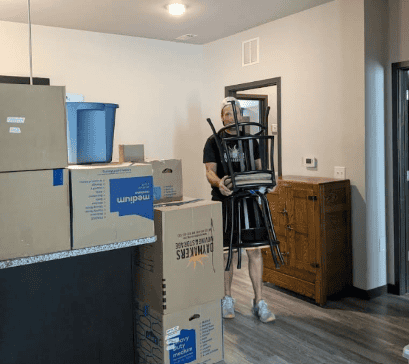
Protection goes in before a single item is carried. Runners down the traffic path, padding on doorframes, covers on banisters and corner guards at every turn, all of it installed while the truck is still closed. The homes that come through a move unmarked are the ones where that work happened first, and it is a large part of what separates professional movers from a crew that simply starts lifting.
Most damage on moving day is not dramatic. It is a scuff along a hallway wall at hip height, a gouge where a dresser corner met a doorframe, a dent in the stair nosing. None of it happens during the careful part of the job. It happens on the twentieth trip, when a heavy item is being walked backwards through a space that was never measured.
The Protection That Goes In Before Anything Moves
The first twenty minutes of a move look like nothing is happening. A crew walks both addresses, agrees the route out and the route in, then lays protection along that whole path. Neoprene or canvas runners on hard floors, adhesive film on carpet in high-traffic stretches, and masonite sheeting where something heavy is going to roll.
Doorframes get padded sleeves or foam wrap at the exact points a sofa arm will meet them. Banisters get covered, because a stair rail takes more contact during a move than almost any other surface in a house. Corners where a hallway turns get board protection, since that is where momentum and geometry disagree. The protection stays up until the last item is through, and it comes down only when the truck is loaded.
Minnesota adds a problem most of the year. Snow, salt and grit tracked in from a driveway will scratch hardwood faster than any piece of furniture will, so the runners do double duty as a barrier against what is on the crew’s boots. In winter our crews lay more floor covering, not less, and extend it further past the entry than a drier climate would need.
How Furniture Is Wrapped Before It Leaves the Room
Walking through a home with tight hallways or a stairwell you are worried about? Call (651) 461-1951 and tell us at the walkthrough, and we will plan the route and the protection around it rather than improvising on the day.
Where Damage Actually Happens
Knowing where the risk sits is most of avoiding it. In the Bloomington homes we work in, the same handful of points come up repeatedly, and almost all of them are transitions rather than open spans.
- Stair turns and landings. A pivot with a long item is the single highest-risk moment in most moves.
- Doorframe strike plates. The narrowest point on any route, and the one people forget to measure.
- Hallway walls at hip height. Scuffs here come from hands and elbows, not furniture.
- Entry thresholds. Where grit gets ground into the floor by repeated foot traffic.
- Elevator door jambs. In apartment and condo buildings, usually the surface the building actually inspects afterwards.
- Low ceiling fixtures. Easy to miss when a crew is watching the floor.
Handling the Items That Threaten a House Most
A piano, a gun safe or an oversized sectional is not simply a heavier version of a normal item. Weight concentrated on a small footprint is what puts a hole in a floor or cracks a stair tread, and that risk is managed with equipment rather than with extra people.
Heavy items go on skid boards or stair-climbing dollies with straps rated for the load, over protection laid specifically for that route. The crew agrees the sequence out loud before anything is lifted, because reversing a piano out of a stairwell is how both the house and the people get hurt. The same planning applies to pianos, safes, and oversized furniture of every kind. Where something genuinely will not fit, we say so and work out an alternative, which is usually disassembly, a different exit, or occasionally hoisting. Finding that out at the walkthrough is free. Finding it out with the item wedged is not.
Why the Crew Matters More Than the Materials
Any company can buy runners and blankets. What decides whether they get used properly on the fifth hour of a long day is who is carrying the furniture. Every mover on our crews is a trained W-2 employee of ours, not day labor hired that morning, and protection discipline is something we train and hold people to.
That distinction shows up in the small decisions nobody is watching. Whether the runner gets repositioned after it slides. Whether a second person is called over for an awkward pivot instead of the first one forcing it. Whether the protection stays on the banister through the last load or comes off early because the day is running long. A crew accountable to the company that hired them makes those calls differently than a crew assembled for one job, and that is what a home looks like at the end of the day.
We would rather protect a home properly than explain a repair afterwards.
Call our Bloomington office at (651) 461-1951, stop by 8400 Normandale Lake Blvd #920, or contact us for a free moving quote, and we will build the estimate, the route and the protection plan around your actual home. We are open Monday to Friday 8 am to 5 pm, Saturday 8 am to noon, and Sunday by appointment.
Related Topics:
