

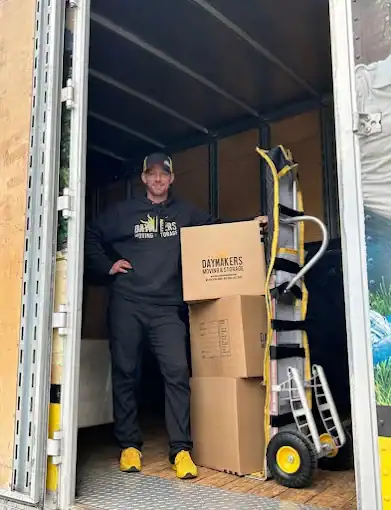
A box marked kitchen that turns up in the garage is an annoyance. A box that never turns up at all is a different problem. The written inventory separates the two, because every item we load gets a numbered tag tied to a line on a master list.
We have used that process on every move out of Roseville, Minnesota since Daymakers Moving & Storage opened in 2015. We own our trucks and employ our crews directly. Whoever tags your dresser at pickup works for the company checking it off at delivery. Our moving company in Roseville, MN applies the same tagging standard to a local job and an interstate one.
What Inventory Tagging Is
Inventory tagging means assigning a numbered label to every item loaded onto the truck. Each tag matches a line on a master inventory list. When we unload, our crew checks each tagged item against that list.
Everything that left your Roseville home should be accounted for at the new one. This is not a formality. The inventory list becomes part of the bill of lading, the legal contract between you and your mover. If an item is missing at delivery, the inventory record establishes that the item was loaded and accepted by the crew. Without an inventory, a claim for a missing item becomes a word-against-word dispute.
For an interstate move, federal rules require your mover to give you a bill of lading and the FMCSA Rights and Responsibilities booklet. FMCSA is the Federal Motor Carrier Safety Administration, the agency that regulates interstate household goods carriers. We are registered with it for interstate work, and the inventory travels with that paperwork. On a local move inside Minnesota, the standard varies by company, and we inventory local jobs the same way.
How Labels Work on Boxes and Furniture
Labels on boxes and furniture serve two different purposes. Box labels direct traffic, telling theour crew where each box goes in the new home. Furniture tags document what was loaded.
Box labeling for destination routing. Each box should be labeled with the destination room at a minimum. Color-coded labels by room speed up unloading because the crew can sort boxes at the truck door before carrying them inside. A box with a green label goes to the kitchen. A box with a blue label goes to the master bedroom. Nobody has to read every label, because the colors do the sorting.
Adding the contents to the label is optional but useful for the person unpacking. “Kitchen: pots and pans” is faster to locate than opening every kitchen box looking for a specific item.
Numbered tags for inventory tracking. Furniture pieces and larger items receive numbered tags that correspond to the master inventory sheet. The crew member loading the truck records each number as the item goes on. At delivery, the numbers are checked off as items come off the truck.
On a long-distance move out of Roseville, the numbered system carries more weight. A full household produces more line items than anyone can hold in their head. The truck may also be on the road for several days. Knowing how delivery windows work tells you when to expect the truck. The numbered list tells you whether all of it arrived.
How the Inventory Connects to Your Bill of Lading
The bill of lading is the document you sign before the truck leaves your Roseville home. It outlines the agreed price, the pickup and delivery addresses, the payment terms, and the inventory of what is being moved.
The inventory attached to the bill of lading is your legal record. Before signing, review it. Every item of significant value should be listed. If a piece of furniture is missing from the inventory and never arrives, your recourse is limited. Nothing documents that it was loaded in the first place.
Once our crew finishes loading, ask to review the inventory sheet before you sign it. Four things are worth checking line by line.
- Every high-value piece sits on its own line, not inside a bundled entry such as miscellaneous
- Any condition notes beside an item match what you can actually see on it
- The pickup and delivery addresses are written correctly
- The payment terms match the written estimate you were given after the walkthrough
At delivery, check every numbered item off before you sign the receipt. Confirm each one is present and in the condition it was loaded in. If anything is missing or damaged, note it on the delivery receipt before signing. Photographs are your best documentation.
We can walk you through a blank inventory and bill of lading during the estimate, in person or over live video. None of the paperwork should be new to you on moving day.
What Changes for an Office Move
Commercial moves involve more inventory complexity than residential moves. An office relocation on the Highway 36 corridor in Roseville might involve dozens of desks, chairs, filing cabinets, and monitors. Each one has to land in a specific spot in the new space, not just in the right building.
For commercial moving services, the inventory and labeling system typically adds a location code to each tag. Instead of a room name, each item carries its destination in the new office. Desk 4A, conference room 2, storage room B. That lets the crew place items directly instead of staging everything in one area and sorting it later. The business loses less time.
We agree on the labeling scheme with your point of contact before move day. Our crew arrives knowing where everything goes, not just what is on the truck.
What Happens When an Item Is Missing at Delivery
If your inventory check at delivery reveals that a tagged item is not present, the steps to take are clear and sequential.
Note it on the delivery receipt before the crew leaves. This is the most important step. A delivery receipt signed without notations of missing items makes a later claim significantly harder to pursue. Photograph the receipt with your notation on it and keep a copy.
Contact the claims department in writing as soon as you can. On an interstate move, federal rules give the carrier 30 days to acknowledge a written claim. It then has 120 days to pay it, deny it, or make a firm offer. A late truck is a separate issue from a missing item, and a delayed interstate delivery runs by its own set of rules.
Provide the inventory number and description of the missing item. The numbered tag system is what makes this documentation possible. Without it, the claim is harder to process and slower to resolve.
We have been a BBB Accredited Business since March 2018. The reviews that mention our crews most often describe careful handling and a walkthrough at the end. Labeling is where that habit starts.
Frequently Asked Questions
What is an inventory tag on a move?
Do local moves get an inventory too?
What should I check before I sign the inventory?
What do I do if something is missing at delivery?
How long does a mover have to settle a claim?
Planning a move out of Roseville, MN this season? Call our Minnesota office at (651) 955-1283 or request a free moving quote on our site. We will book a walkthrough, send a written estimate, and show you the inventory paperwork before moving day rather than on moving day.
Related Topics:
