

Move-in weekend at UW-Eau Claire runs on a timed schedule, a shared elevator, and a parking plan set by someone other than you. Every piece of advice worth giving follows from those three constraints. Families who treat it like a normal move and show up with a full truck at noon learn this the hard way.
Each August, moving services from Daymakers Moving & Storage handle a steady stream of student moves into campus housing and the apartment blocks around it. What follows assumes you are working inside the university’s window rather than around it.
Read the University's Schedule Before Anything Else
Residence halls assign move-in times, and those assignments exist to stop four hundred families arriving at one loading zone simultaneously. Your window is usually a few hours on a specific day, published by the housing office in advance. Confirm it directly with them rather than with what a returning student remembers. Halls change procedures and building access rules more often than people expect.
Build the rest of the day backward from that window. If your slot is nine in the morning and you are driving from out of state, you are staying nearby the night before. Hotels in Eau Claire fill for move-in weekend the same way they fill for graduation, which is to say early. Book the room when you get the housing assignment, not when you finish packing.
Pack Less Than You Want To
A residence hall room is small, shared, and already furnished with a bed, a desk, a chair, and storage. Everything you bring competes for the remaining floor space with another person’s belongings. The single most common August mistake here is packing for a house and arriving at a room. It is the first thing we flag to anyone moving to college.
What consistently earns its space:
- Bedding sized to the actual mattress. Many halls use extra-long twin, so measure or confirm rather than assume.
- A shower caddy and flip-flops, for shared bathrooms.
- A power strip with surge protection, since outlets are few and far apart.
- Layered clothing for one season, with the rest staying home until a break.
- A small tool kit and a first aid kit, both of which get borrowed constantly down the hall.
Leave the furniture at home. Leave candles, halogen lamps, and anything with an open flame, because they are banned in most halls and will be confiscated. Check the housing prohibited-items list before buying a mini fridge or a microwave. Size limits vary by building, and an oversized appliance becomes a problem you carry back down four flights.
Plan the Carry, Not Just the Drive
The distance from where you can legally stop to where the room actually is determines how long the day takes. Some halls have a loading zone at the door. Others have you unloading onto a cart, moving the vehicle immediately, then walking the cart a considerable distance. Find out which situation you are in before you arrive. The second one requires at least two people and a plan for who stays with the car.
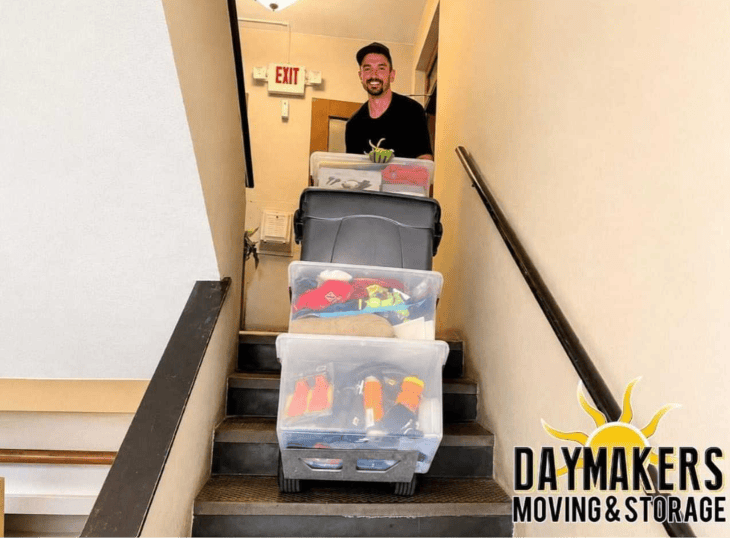
Pack for that carry. Fewer, sturdier containers beat a car boot full of loose bags and open laundry baskets. Label everything with the student’s name and room number, since identical boxes in a shared hallway become a guessing game fast. Soft-sided duffels handle stairs better than rigid suitcases. A folding hand truck pays for itself in one trip if your building does not supply carts. Most of our other local moving tips apply here too.
Understand the Elevator Problem
Most residence halls have one or two elevators serving several hundred people on the busiest day of their year. On move-in weekend, those elevators run continuously with queues at both ends. Anything you can carry up stairs, carry up stairs. Anything you cannot carry goes in the elevator queue, and that queue is the reason a two-hour move becomes a five-hour one.
This is where an early window genuinely matters. The first slot of the day faces a fraction of the traffic the midday slots do. If you have any influence over which window you receive, ask for an early one. If you receive a late one, expect to wait and plan lunch accordingly. Off-campus apartment buildings around the university have the same problem in a smaller form. Most require an elevator reservation that you have to request in advance.
Moving into an off-campus apartment with a tight stairwell or a strict move-in window? Give us a call at (715) 500-6172, and we’ll size the crew to the building before move-in weekend fills up.
Moving Into Off-Campus Housing Instead
Leases in the neighborhoods around campus turn over within the same few days. That concentrates demand and makes parking scarce across whole blocks. Older houses divided into units are common here, with staircases that were built long before anyone owned a sectional. Measure the stairwell before you buy furniture for a second-year apartment.
An apartment moving service built for exactly this handles buildings with access rules, tight approaches, and a fixed window to work inside. We handle the reservation requirements and size the crew to the stairwell rather than the square footage. The flat rate is set after a walkthrough, so a slow elevator does not become a line item. On local jobs within a hundred miles, the crew is ours, the truck is ours, and your belongings stay on one vehicle throughout.
What to Do About Summer Storage
The gap between spring move-out and fall move-in is the other half of student life here. Hauling everything home to Minneapolis or Madison twice a year is the expensive way to solve it. Climate-controlled storage holds a unit at a stable temperature and humidity, which protects electronics, instruments, and anything upholstered across a Wisconsin summer.
The practical version: pack in uniform boxes, label on two sides, keep an inventory on your phone, and put nothing perishable in. Students sharing a unit between them cut the cost considerably, though it is worth agreeing in advance who is collecting what and when. Book storage before finals rather than during them, because the last week of the semester is when every unit in town gets spoken for.
Make the First Night Work
Set the bed up first, before anything else comes out of a box. A made bed at the end of a long day matters. It is the difference between a student who settles in and one who sleeps surrounded by cardboard. Bathroom supplies come out second, then whatever is needed for the morning.
Everything else can wait. Breaking down and removing the boxes matters more than that first evening than unpacking them. Floor space in a shared room is the scarcest thing in the building. Most halls set out recycling for exactly this, and it fills quickly, so getting there early is worth the trip. Then leave. The unpacking gets finished faster once the room belongs to the person living in it.
Whether it’s the residence hall or an apartment across town, call (715) 500-6172 and we’ll help you plan around the schedule you don’t control.
Related Topics:
