

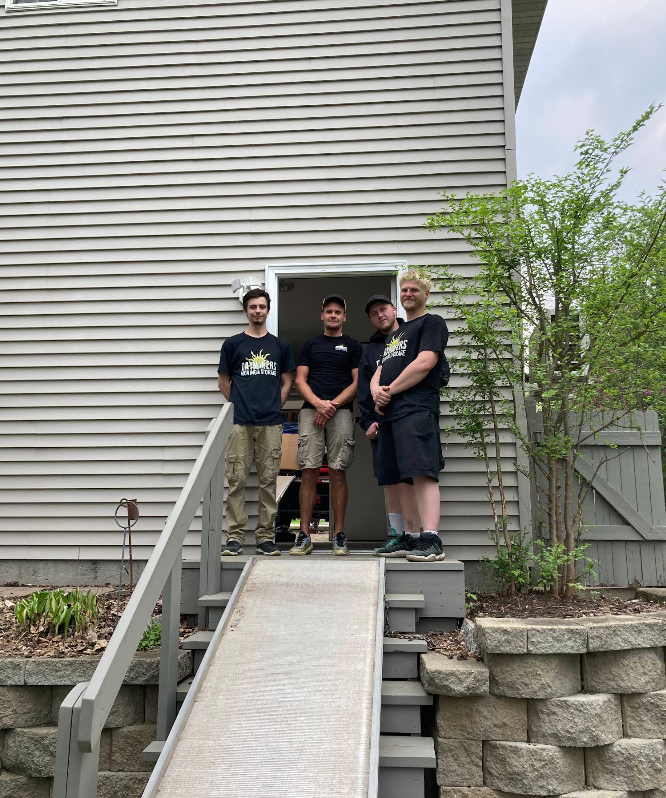
Access charges exist because distance and stairs cost labor, not because a mover is padding an invoice. A flight of stairs can add forty percent to the time a room takes. A long walk from door to truck multiplies every single trip.
Roseville movers who quote without seeing the property are guessing at both. We measure the carry path during the walkthrough and write the result into the estimate. The number you receive already accounts for the building.
What Counts as a Stair Carry or a Long Carry
A stair carry means any flight the crew negotiates with loaded weight. That covers a walkout basement, a split entry or a third floor apartment. The count that matters is flights between the item and the truck, not flights inside the home generally. Four steps up from a sunken living room is not a stair carry. Two full flights down to a basement storage room is.
A long carry is measured from the door of your unit to the back of the truck. The threshold varies between companies, which is why it belongs in writing rather than in conversation. Long driveways, rear entrances and interior courtyards all stretch that distance. So does a building where the loading zone sits around the corner from the door.
Which Roseville Properties Tend to Trigger Access Charges
Roseville, MN has a housing mix that produces these conditions often. Split levels and walkouts are common through the older residential pockets. Both put a half flight between the main floor and the driveway. Mid century homes near the county road corridors frequently have narrow stairwells with a tight turn at the landing. That turn slows a sofa more than the stair count alone suggests.
Apartment and condo buildings bring a different version of the same problem, and experienced apartment movers have seen all of them. Some buildings have a service elevator with reserved windows, while others have a single passenger elevator shared with every resident. Buildings along the busier corridors often restrict loading to a marked zone rather than the nearest door. The building rules usually shape the plan more than the furniture does.
How Elevators Change the Calculation
An elevator removes the stairs and introduces waiting instead. A reserved service elevator with padding and a held door is close to ideal. The crew runs a steady loop without interruption. A shared passenger elevator in a busy building is the opposite, and crews can lose large stretches of a morning standing in a lobby.
Booking the elevator is the highest value thing a resident can do before moving day. Most buildings require reservation in advance. Some charge a deposit, and a few restrict moves to certain days entirely. Confirming those rules a week out changes the shape of the day considerably. So does sorting out truck prep for multi story apartment moves once the route is known.
Live somewhere with stairs, a tight entrance, or a shared elevator?
Give us a call at (651) 955-1283, and we’ll measure the carry path and confirm the building rules before you commit.
What Drives the Cost Beyond the Stairs Themselves
Several conditions compound each other, and the combination matters more than any single factor. These are the ones we measure during the walkthrough:
- Flights between the item and the truck, counted at both origin and destination.
- Distance from door to truck, including any stretch the truck cannot legally park closer to.
- Turn radius at landings and doorways, which decides whether large pieces need disassembly.
- Elevator type and availability, including whether a window has to be reserved.
- Surface and grade of the carry path, since gravel, slopes and uneven pavement all slow loaded trips.
None of these produce a figure we can quote over the phone, and we do not try. Every estimate follows a walkthrough, done in person or by live video. The written number reflects what we actually saw. If the access turns out easier than expected, that works in your favor rather than ours.
How to Reduce Access Charges Before Moving Day
Some access conditions are fixed by the property. No amount of preparation changes a third floor walkup. Others sit entirely within your control, and those are worth attention. Clearing the carry path of bikes, planters and stored boxes keeps the route at full width. That matters more than people expect on a narrow stairwell.
Parking is the other lever. Reserving the spaces closest to the door can cut the carry distance substantially. The same goes for securing a permit where the street requires one. Moving smaller boxes yourself to a ground-floor staging area shortens the loop, though only if it happens before the crew arrives. Reading up on parking permits and loading zones is sensible for anyone moving from a building with restricted frontage.
Frequently Asked Questions
It is measured in flights between the item and the truck rather than in individual steps. A few steps at an entry is normal access. A full flight to a basement or an upper floor is a stair carry. It should be identified at the walkthrough rather than on moving day.
Sometimes. If a legal space nearer the door is available and the truck fits it, the carry shortens, and the charge reflects that. Many buildings and streets restrict where a truck can sit. A crew will not block a fire lane or a hydrant to save distance.
Usually, though not always. An elevator removes the physical flights but introduces waiting. A single shared elevator in a busy building can take longer than two flights of stairs. A reserved service elevator is normally the fastest option available.
Yes. Access conditions are written into the estimate after the walkthrough. That is the reason we do not quote by phone. Surprises on an invoice usually mean nobody looked at the property first.
Both ends are assessed. A ground floor pickup going into a third floor apartment carries the access conditions of the destination. Those belong in the estimate just as clearly as the ones at your current address.
Contact Us
Stairs, narrow landings, and building elevators are worth sorting out before you book rather than after. Call our Roseville office at (651) 955-1283 or email Daymakersmoving@gmail.com to schedule a walkthrough. Our hours are Monday through Friday from 8 am to 5 pm, Saturday from 8 am to noon, and Sunday by appointment.
Related Topics:
